

What is current
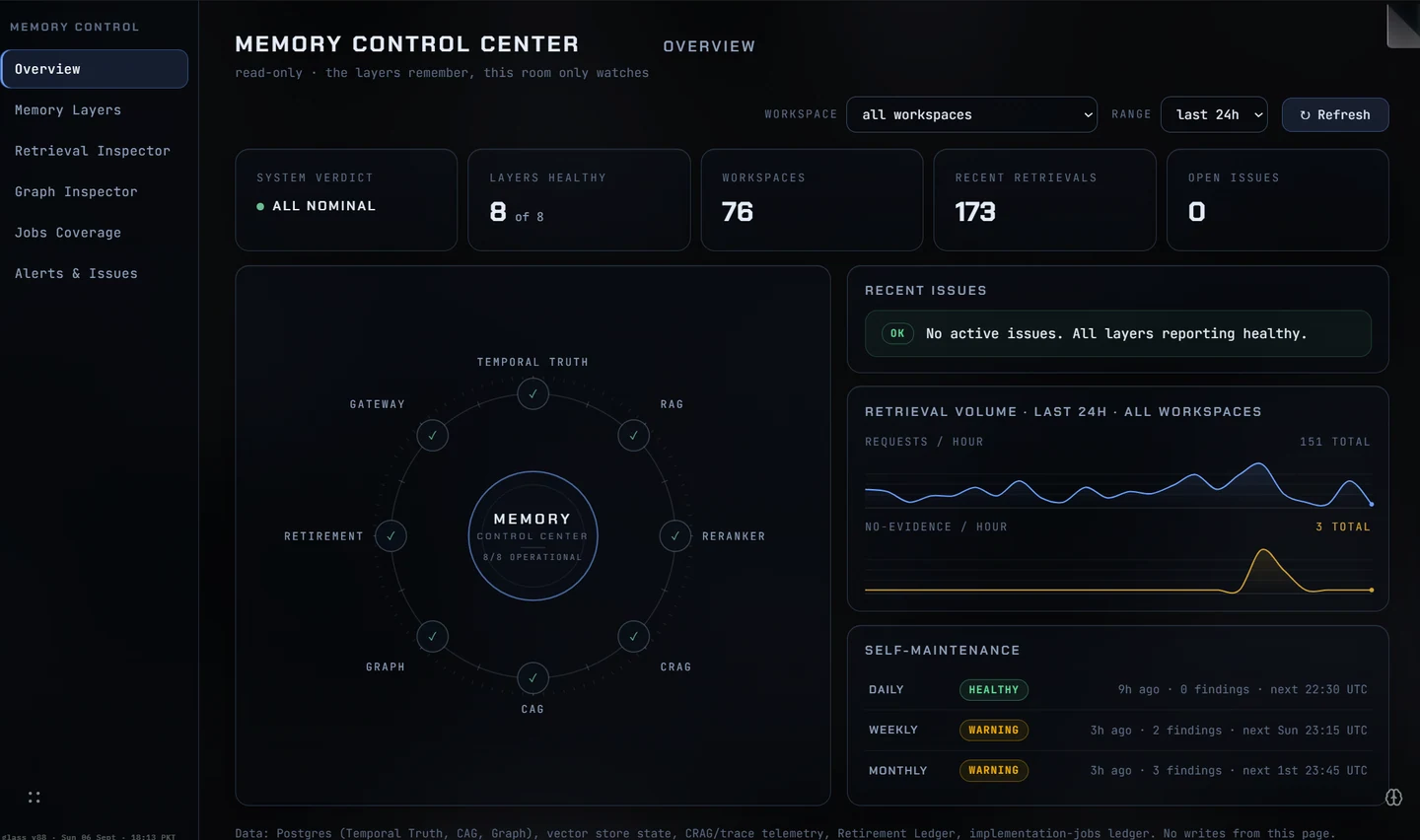
Current facts with scope, provenance and a history of what changed.
EnochOS connects organizational memory, AI workers and operational oversight. Turn a request into defined work, carry its context forward and inspect the evidence behind delivery.
From the first source to the next decision. See how EnochOS brings knowledge, execution and verification into one operating environment.
Focus the video player and press Space or K to play or pause. Use the playback and volume sliders to seek and adjust sound.Captions are included in the film.
Conversation, Factory, memory and inspection have distinct jobs. Move between them without losing the work they belong to.
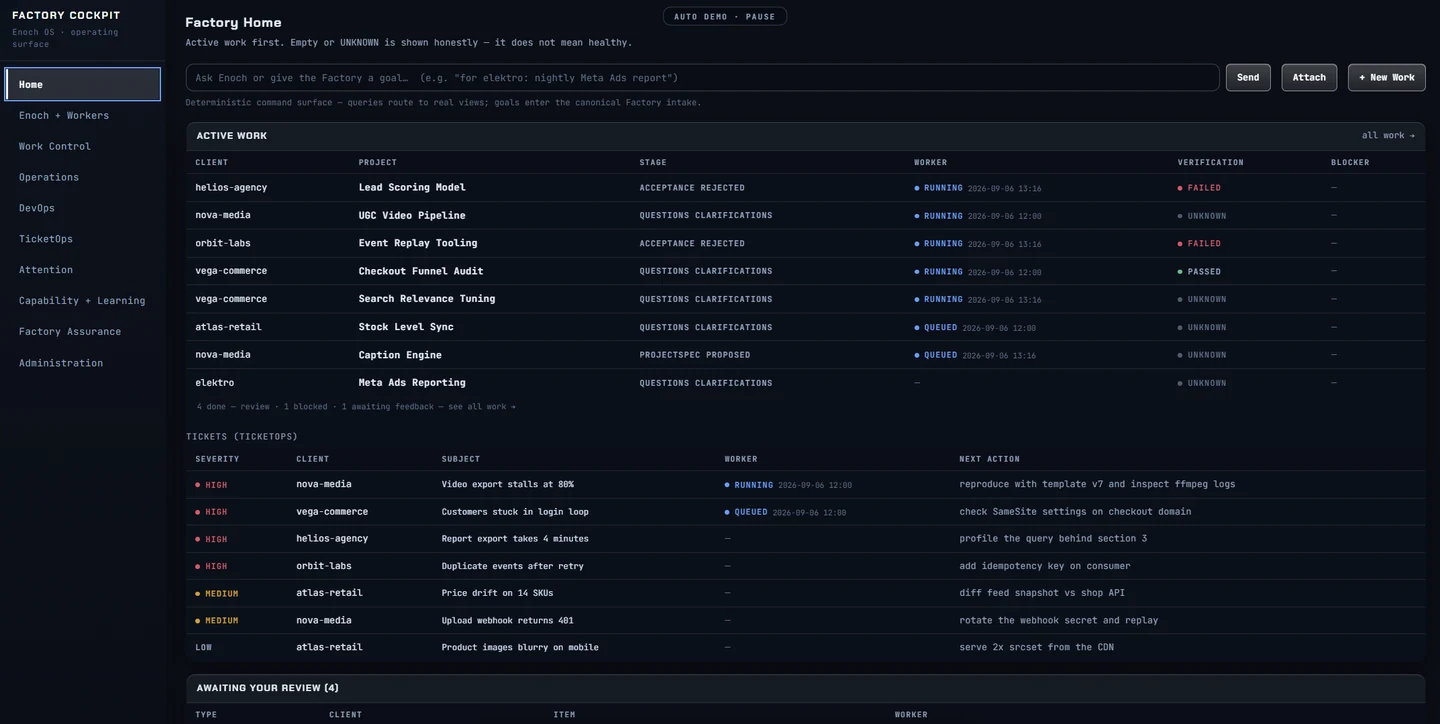
See work, tickets and review queues together.
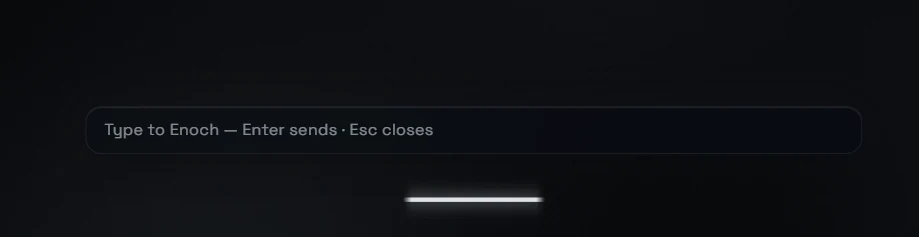
A persistent interface for requests, decisions and control.
Factory brings active work, attention and oversight into view.
Memory and terminal surfaces make context and execution visible.
Open a workspace. Inspect a worker. Recall a decision. Type a request or complete a spoken turn. The interface puts the next useful action within reach.

Preserve what was asked. Define what is approved. Give the work clear boundaries—and decide how completion will be demonstrated before execution begins.
Original evidence stays connected to the work.
Files, messages, screenshots and observations retain their origin and scope.
Illustrative workflow. Permissions, dispatch and acceptance gates are defined for the implementation.
Follow projects and the next decision they need.
Knowledge belongs to the organization. EnochOS separates source evidence, current facts, retrieved context and history so a new session can begin with the right foundations.
Current facts with scope, provenance and a history of what changed.
Retrieve evidence that is relevant to the work and permitted for its scope.
Order retrieved evidence so the most relevant material gets attention.
Evaluate retrieved material and identify when context needs correction.
Use bounded context packs without turning a cache into a source of truth.
Navigate source-backed links between entities, records and work.
Keep the distinction between current, superseded and retired knowledge visible.
Expose the relevant memory operations through the controlled access layer.
Retrieval helps find context. It does not decide what is authoritative. Missing or conflicting evidence can remain UNKNOWN.
Inspect memory health, retrieval and maintenance.
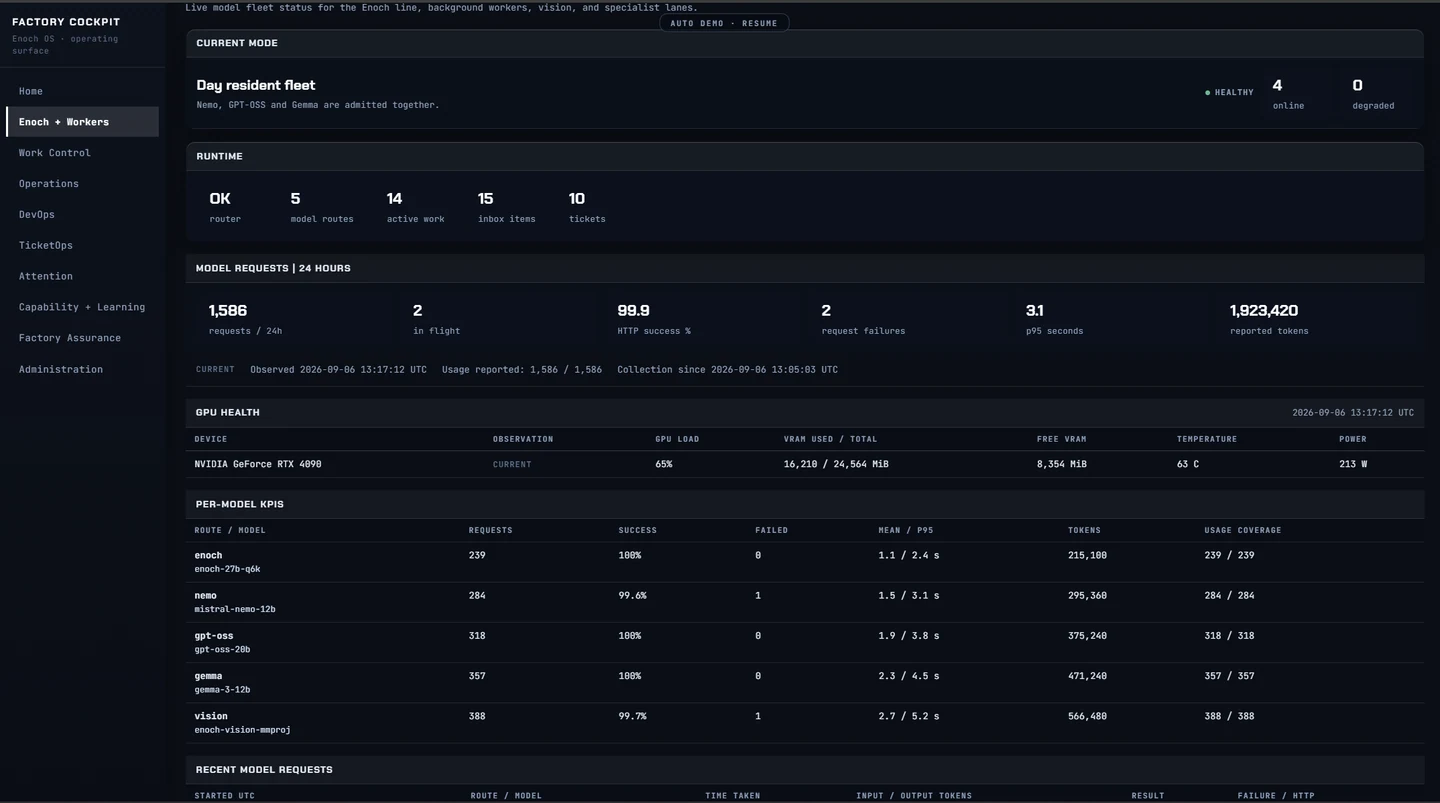
Route reasoning, engineering and inspection to the appropriate resource. The project, job and evidence remain anchored outside the individual worker session.
The persistent operator experience for requests, control and the next useful action.
Architecture illustration. Worker replacement does not imply instant provider failover; transitions follow the configured operating controls.
Inspect model routes, worker activity and system telemetry.
A worker finishing is one event. Verification is another. Inspect the result against the agreed criteria, identify what is missing and route corrections to the right layer.
Proceed to the defined acceptance step.
Correct the execution against the approved plan.
Revise how the approved requirement will be met.
Version the specification before changing the work.
Inspect quality measures alongside their definitions.
Bring managed systems, meaningful health signals, tickets and attention into the same operating picture. Follow an issue from the first observation to the evidence of recovery.
Review healthy, degraded and unknown system states.
Check meaningful health criteria and their freshness.
Connect the signal to system context and supporting evidence.
Make the required decision before a consequential change.
Apply the permitted repair and verify the resulting state.
Health contracts define what matters for a managed system. Fresh, degraded and unknown states remain distinct.
Keep capabilities, components and blueprints in a governed registry. Find what can be reused, understand what needs adaptation and make a missing capability visible.
Use an existing, suitable capability.
Set the required operating parameters.
Change a capability within an agreed scope.
Connect proven parts into the required workflow.
Make the missing capability explicit.
Resolve the constraint before proceeding.
Track reusable assets, gaps and acquisition work.
Understand deployed reality before changing it. Connect the source, system, responsible people and operating evidence into an agreed management scope.
Inspect. Reconcile. Define. Verify.
Specific integrations, identity and hosting requirements are confirmed against the implementation.
A reconciled view of source and deployment
Defined rights and operating responsibilities
A baseline your team can review
Begin with a bounded workflow and a clear definition of success. Build the implementation around your architecture, operating responsibilities and review requirements.
Map the workflow, existing systems, evidence sources and decisions that need a clear owner.
Configure the operating surface, knowledge boundaries and execution path around an agreed use case.
Review the required evidence with your team. Resolve gaps before extending the implementation.
Maintain visibility, respond to the agreed operating needs and develop the next capabilities deliberately.
Identity, access, data lifecycle, recovery and operating requirements belong in the architecture conversation from the start.
Book an enterprise walkthroughA fully in-house engineering team, with named people responsible for architecture, implementation and delivery. Five supporting engineers. No subcontracting.
LinkedIn Marketing Academy credentials
Former Audi robotics engineer
Oxford and Bahçeşehir higher education
LCCI committee convener
Operations experience at Arsann & KDTC
Selected RECAST work across AI, custom software and operational systems. These stories demonstrate our team’s delivery experience; each case explains its own scope.
A structured research system, persistent company and candidate records, confidence signals and a review workspace.
 Carl Peterson & Brian Model
Connected creator discovery, reusable research pools, review workflows and coordinated handoffs.
 Michael Schmidt
A branded financial workspace connecting client access, reporting and read-only accounting data.
 Saadi Sabah







A closer look at the product, its architecture and the decisions that shape an implementation.
EnochOS is a persistent operating environment for governed AI work. It brings organizational memory, project specifications, worker execution, verification and managed-system oversight into one product.
AI Layer puts connected agents into department workflows. EnochOS adds a deeper institutional foundation for complex work: versioned specifications, execution boundaries, durable jobs, verification records, operations and reusable capabilities. We help determine which level fits your requirements.
Project state, evidence and jobs live outside individual model sessions. EnochOS coordinates defined reasoning and execution resources, including Codex and Claude. A provider interruption can still affect generation; preserving state gives the team a foundation from which to continue.
It means source evidence, scoped facts, work state and history are stored as organizational records. Retrieval and cached context help a worker use those records. They do not silently replace the approved facts or requirements.
The architecture carries scope through intake, retrieval, facts and relationships. Your implementation defines the applicable boundaries and access requirements. Identity, retention and assurance requirements are reviewed during technical discovery.
No. Execution follows the permissions, contracts and decision gates defined for the workflow. Some intake dispatch and worker transitions require explicit operator action. The operating surface keeps attention, intervention and the next decision visible.
The acceptance contract defines what a result must demonstrate. Verification records the evidence and a pass, fail or blocked outcome. Independent checking and human acceptance are applied where required by the workflow.
Yes, through an implementation scoped to the actual system and available access. We inspect deployed reality, source relationships, responsibilities and operating evidence before defining what EnochOS will manage or monitor.
We evaluate identity, access, data lifecycle, hosting, recovery and operating requirements with your team. Broader enterprise identity controls, including SSO and SCIM, and formal retention or DR/SLA guarantees are not completed standard capabilities. We review these requirements during discovery and define the available scope.
No. A completed job and a reusable capability are different things. Rights, generalization and proof are reviewed before a result becomes an approved capability, component or blueprint. Client data is not automatically shared or treated as training material.
These are actual EnochOS interface captures. Factory views marked AUTO DEMO contain demonstration data; their counters are not customer performance results. Diagrams explain the architecture and are labeled when they illustrate a workflow.
An enterprise walkthrough focused on one important workflow. We map the systems, knowledge, operating constraints and acceptance evidence, then define a practical first implementation with your team.
Bring the process, the systems and the decisions that matter. We’ll map where EnochOS can fit—and what a successful implementation should prove.
Book an enterprise walkthroughEnochOS. Enterprise knowledge, put to work.